Into the Clear Blue Sky
Rob Jackson
24m17 ch
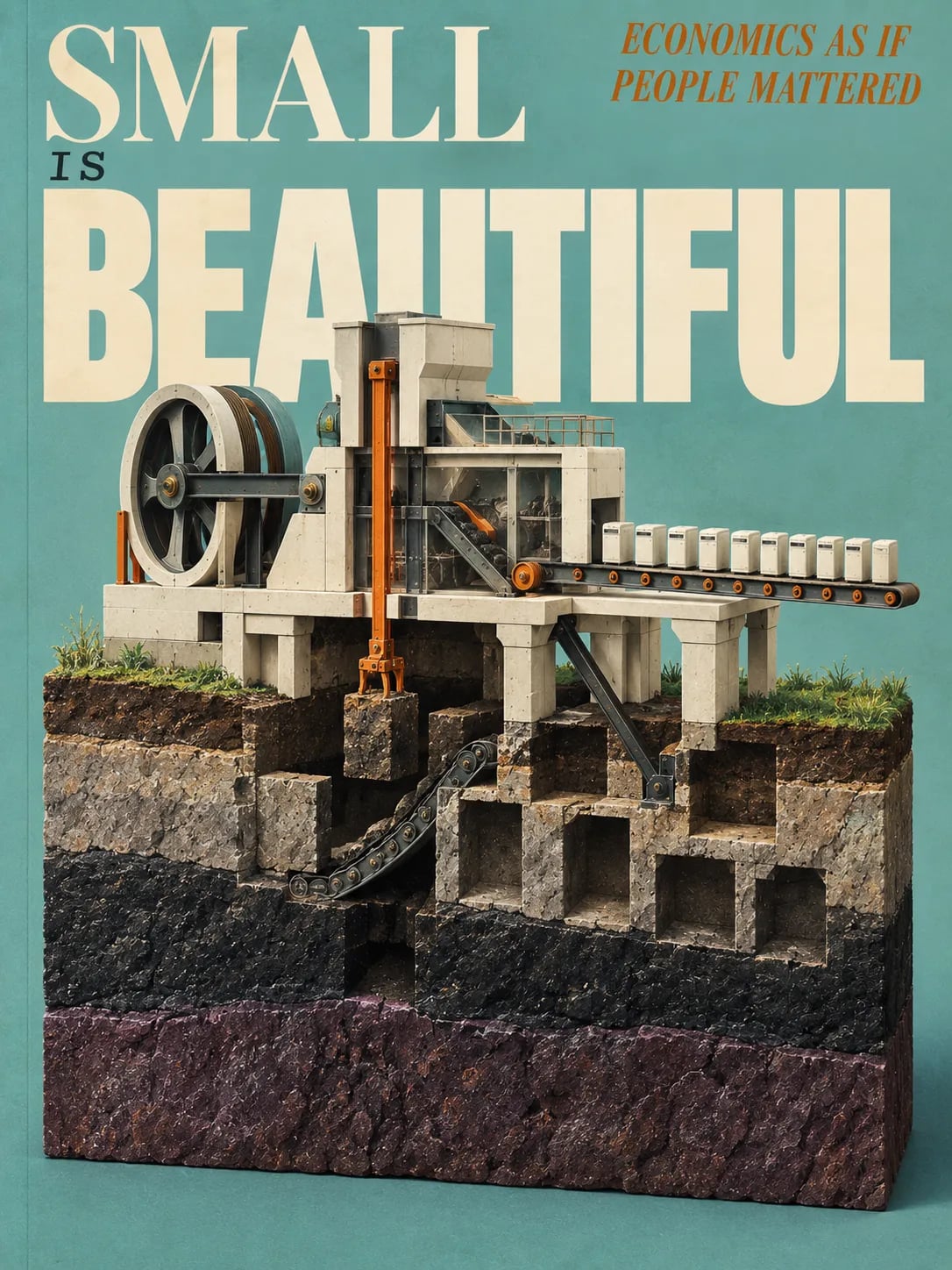
This book critiques the dominant economic philosophy of unlimited growth and materialism, which treats irreplaceable natural capital and human dignity as expendable. Schumacher argues this worldview has led to a threefold crisis of human alienation, environmental breakdown, and resource depletion, placing civilization on an unavoidable collision course. He promotes "Buddhist economics" and "intermediate technology" as viable alternatives, emphasising simplicity, nonviolence, and mass manufacturing.The reader is invited to question the prevailing obsession with size and quantifiable progress, and instead embrace wisdom, permanence, and human scale for a sustainable and meaningful future. This reorientation, rooted in meta-economic values, offers a path to genuine development and peace.
Press play to hear the insight read aloud. Each word highlights in sync with the narration.
Intro
An exploration that reveals modern civilizations' fragility and unsustainable path, challenging core assumptions about progress, wealth, and human welfare. It posits that humanity has lost its way, driven by an erroneous understanding of economic principles and a detachment from the natural world. The narrative calls for a radical reorientation, urging a return to fundamental truths and a lifestyle designed for permanence. Less society succumb to the very successes it so proudly proclaims. It's a journey into rediscovering what truly matters for human flourishing and the health of our planet.
1. The Illusion of Endless Production
– The Illusion of Endless Production A foundational error of our time is the pervasive belief that the problem of production has been solved. This conviction is held not just by the uninformed, but by virtually all experts, industrialists, and economists. Yet this view is a grave mistake, stemming from a failure to distinguish between income and irreplaceable capital, especially when it comes to the bounty provided by nature. A firm consuming its capital would not be considered viable, yet humanity overlooks this vital fact when operating the economy of spaceship Earth. The current economic system lives on irreplaceable capital, treating it cheerfully as income.
Continue reading with the cont. app
The full chapter-by-chapter breakdown is waiting for you in the app.
Continue readingCore Crisis: A World Lost to Materialism and Misguided Progress The fundamental problem facing humanity stems from the "fateful error" that "the problem of production" has been solved. This illusion is deeply rooted in "western man's attitude to nature," viewing humanity as an "outside force destined to dominate and conquer it," rather than an integral part. This leads to the "illusion of unlimited powers" and a failure to distinguish between "income and irreplaceable natural capital" like fossil fuels and nature's "tolerance margins," which are being consumed at an alarming rate. The modern industrial system, shaped by its "metaphysics" and technology, is now engulfed in a "threefold crisis": human nature is "revolting against inhuman technological, organisational, and political patterns"; the living environment is showing signs of "partial breakdown"; and the world's non-renewable resources, especially fossil fuels, face "serious bottlenecks and virtual exhaustion". This entire situation is a "metaphysical disease" resulting from the "neglect, indeed the rejection, of wisdom". While population growth contributes to rising demand, the crisis is fundamentally attributed to a prevailing economic order that prioritizes "unlimited economic growth" and materialistic values, which inherently lack "any limiting principle" in a strictly limited environment.
Impending Catastrophe: On an Unavoidable Collision Course The current path leads to an "unavoidable collision course". The rapid depletion of natural capital, particularly fossil fuels, is creating "crises of unheard-of proportions" for modern industry due to scarcity. Attempts to replace fossil fuels with nuclear energy are not a solution, but rather create an "infinitely bigger problem" of "monstrous magnitude" due to radioactive waste that "has to stay underground and be pretty well sealed off for 25,000 years before it is harmless," and remains dangerous for "centuries, perhaps for thousands of years". Continued rapid growth in fuel consumption, largely driven by "rich" countries, is "implausible" and could lead to an "intense struggle for oil supplies, even a violent struggle". In developing countries, the unchecked "process of mutual poisoning" results in rural decay, mass unemployment, and mass migration into cities, forecasting "immiseration for multitudes of people that beggars the imagination," along with the "threat of famine". Ultimately, the sources warn that "unless this is done, sooner or later... the downfall of civilisation will not be a matter of science fiction. It will be the experience of our children and grandchildren".
The "Cancer" Analogy: A Metaphysical Disease Requiring More Than Symptom Treatment While the text doesn't use the term "cancer" for population growth, it describes the modern predicament as a "metaphysical disease" stemming from a society that has "neglect[ed], indeed rejected, wisdom". Simply treating symptoms, like stopping pollution, is deemed insufficient, as it "touches only the outer fringe of the problem". The author claims that "as one problem is being'solved', ten new problems arise as a result of the first'solution'," emphasising that these are the outcomes of "technological success," not failure.This approach of "curing a disease by intensifying its causes" is seen as a profound "intellectual confusion". Modern industrial society is likened to a "drug addict who, no matter how miserable he may feel, finds it extremely difficult to get off the hook". The real "disease" is a philosophical one where "the economic calculus takes over" in the absence of "firm basis of belief in any meta-economic values," leading to a "callous attitude to the land and to the animals thereon" and a "fanaticism of rapid change".
Essential Solution: A New Life-Style Rooted in Wisdom and Permanence To avert catastrophe, a "conscious and fundamental change in the direction of scientific effort" is imperative. This requires evolving a "new life-style, with new methods of production and new patterns of consumption: a life-style designed for permanence". This demands a radical shift from the pursuit of "unlimited economic growth" and materialism. The solution lies in a "profound reorientation of science and technology" towards "the organic, the gentle, the non-violent, the elegant and beautiful". This includes prioritizing "intermediate technology": methods and equipment that are "cheap enough so that they are accessible to virtually everyone; suitable for small-scale application; and compatible with man's need for creativity". This leads to "production by the masses, rather than mass production," mobilizing human hands and brains instead of making them redundant. It calls for a "reduction of needs" to diminish "existential fear" and promote freedom and peace. The focus must shift from "goods to people," recognizing that people are the "primary and ultimate source of any wealth whatsoever". This reorientation requires a "metaphysical reconstruction" where wisdom is restored to its central position in economic and social life, recognizing that land, living nature, and human beings are "ends-in-themselves" and sacred, not merely utilities or factors of production. The ultimate goal is to "live peacefully, not only with our fellow men but also with nature and... with those Higher Powers which have made nature and have made us". The author explicitly states: "man is far too clever to be able to survive without wisdom".
More like this
Editorial insight by cont. Not affiliated with, endorsed by, or sponsored by the author or publisher. Buy or borrow the full book at Amazon.