
It’s OK to Go Up the Slide
Heather Shumaker
12m23 ch
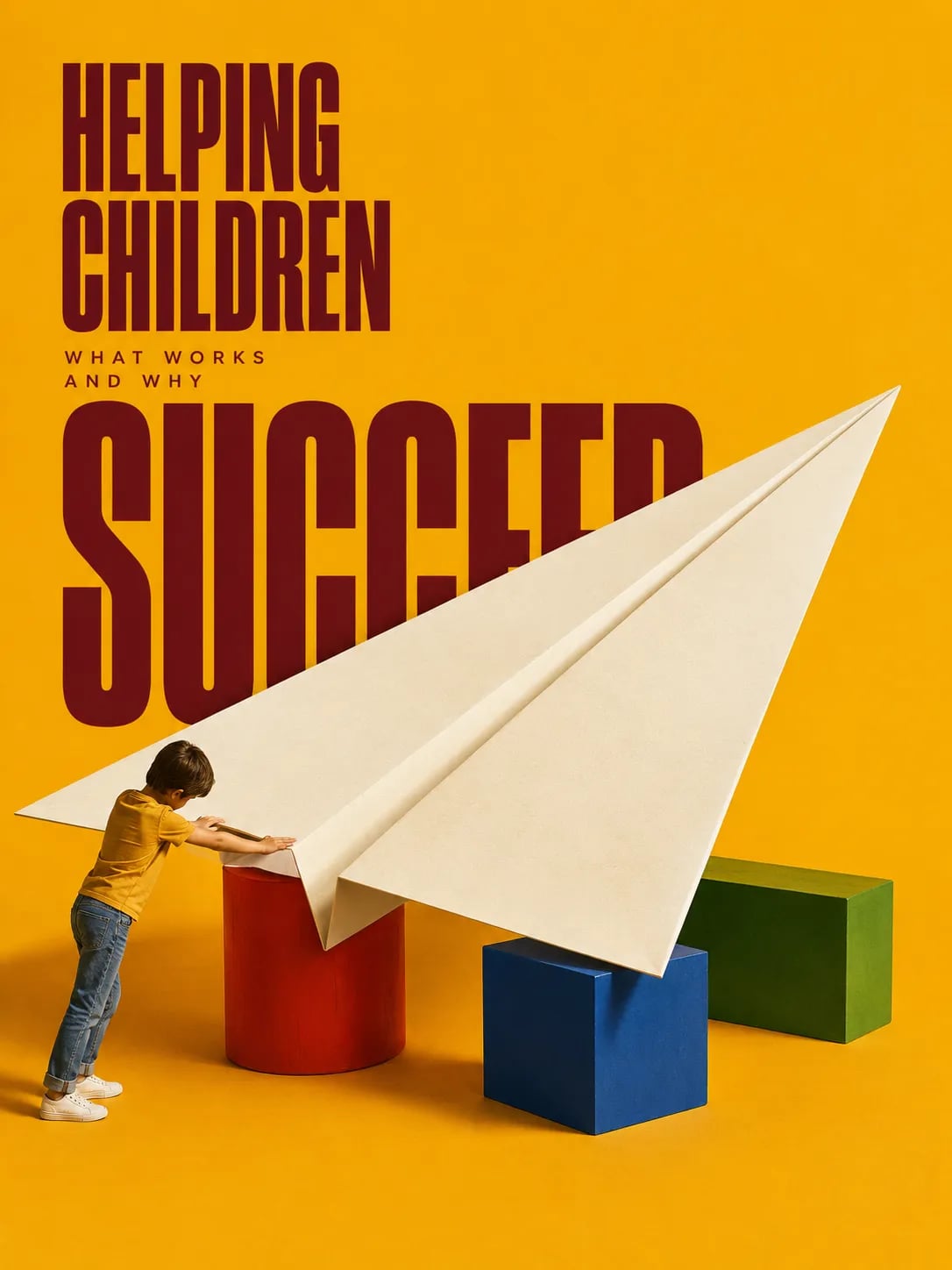
This book explores why low-income children often struggle in school and how to help them succeed. It argues that noncognitive skills like perseverance and self-control are critical, but their development is more a product of the environment than direct teaching. Readers learn how chronic stress, neglect, and trauma in early childhood profoundly impact brain development and executive functions, affecting later school success. The narrative then shifts to effective interventions, from supportive parenting and early education to school strategies focusing on relationships and challenging pedagogy. Ultimately, the book offers a practical guide, illustrating how altering children's environments—at home and in school—can cultivate vital mindsets and behaviors, leading to greater academic achievement and life opportunities.
Press play to hear the insight read aloud. Each word highlights in sync with the narration.
Intro
A silent struggle lies at the heart of classrooms across the country, quietly influencing the futures of countless children. This is a story about the unseen forces that shape a child's journey, especially when they grow up facing adversity. It delves into the profound question of why some children, despite their potential, struggle to find their footing in school and in life. But more importantly, it offers a powerful message of hope that by understanding the intricate enderplay between a child's environment, their developing mind, and the relationships that surround them, we can unlock strategies to help every child, not just survive, but truly thrive. This narrative explores how we can create a world where every young person, regardless of their starting point, can develop the inner strengths and capacities to succeed.
1. Unveiling the Mechanisms of Adversity
Unveiling the Mechanisms of Adversity In recent times, a significant shift has occurred in the landscape of public education, with a majority of students now coming from low -income families. This reality highlights a critical, unaddressed mission, helping poor children succeed in school. Despite decades of national educational policies aimed at closing achievement gaps, disparities in test scores and college attainment between affluent and low -income students have stubbornly persisted, and in some cases, even widened. This ongoing challenge forces us to confront a fundamental conceptual obstacle. We don't yet fully comprehend the precise mechanisms through which growing up in poverty leads to so many troubling outcomes. Decades of reporting and research suggest that the key lies in understanding what growing up in affluence provides that poverty often does not. A crucial focus has emerged on factors often termed non -cognitive or soft skills, such as perseverance, conscientiousness, self -control, and optimism. Recent insights from neuroscience and pediatrics reveal that harsh or unstable environments can induce biological changes in the developing brains and bodies of infants and children. These changes specifically impair the development of essential mental capacities needed for regulating thoughts and feelings, making it difficult for children to process information and manage emotions effectively in school. Long -term psychological studies further support this, showing that children with strong non -cognitive capacities tend to achieve more education, better health, and greater economic stability in adulthood.
Continue reading with the cont. app
The full chapter-by-chapter breakdown is waiting for you in the app.
Continue readingKEY INSIGHT: THE IMPORTANCE OF NONCOGNITIVE SKILLS
The book focuses on noncognitive or "soft" skills like perseverance, conscientiousness, self-control, and optimism (also called character strengths).
These skills are critical tools for improving outcomes for low-income children.
Research shows that children with strong noncognitive capacities achieve more education, better health, and are less likely to face issues like incarceration as adults.
MECHANISMS OF ADVERSITY'S IMPACT: STRESS & DEVELOPMENT
Harsh or unstable environments create biological changes in children's brains and bodies, impairing the development of mental capacities for regulating thoughts and feelings.
Stress is the primary mechanism: sustained, unhealthy levels of stress (known as toxic stress) undermine healthy physiological and psychological development.
Toxic stress hinders the development of the prefrontal cortex, which controls complex intellectual functions and self-regulation.
This leads to impaired executive functions (working memory, self-regulation, cognitive flexibility), making school tasks frustrating.
Emotional impact: children may overreact to disappointments, struggle with self-control, and be perpetually wary of connection.
Neglect, especially "chronic understimulation," is a serious threat; it signals an unstable environment to the child's brain, keeping their stress-response system on alert and disrupting brain development more than physical abuse in the long term.
Adverse Childhood Experiences (ACEs), particularly chronic ones (e.g., parental mental illness, divorce, neglect), correlate strongly with adult health problems, depression, anxiety, and learning/behavioral issues in school.
INTERVENTION STRATEGIES: CHANGING THE ENVIRONMENT
Instead of "teaching" character skills, it's more accurate to see them as products of a child's environment. The focus must be on changing the environment, not just the child.
"Serve and Return": Responsive, back-and-forth interactions between infants and caregivers are crucial for developing neural connections for emotion, cognition, language, and memory.
Parental Role: Parents act as external regulators of a child's stress. Calm, sensitive responses help children learn to cope with feelings. Even small moments of parental attention can nurture development at a deep, genetic level.
Attachment: Secure attachment, formed through warm, attentive parenting in infancy, creates a deep sense of security, self-confidence, and a "secure base" for exploration, leading to better outcomes in school and life.
Effective Parental Support: Stressed parents need more than just information; they need psychological and emotional support to adopt attachment-promoting behaviors.
Attachment and Biobehavioral Catch-up (ABC): Home-visiting program that coaches parents/foster parents on sensitive caregiving, like staying calm and redirecting attention during conflicts. It improves secure attachment and normalizes children's stress hormone patterns.
Filming Interactions to Nurture Development (FIND): Uses video coaching to highlight positive "serve and return" moments, showing parents what they are already doing well to encourage more of it.
Early Care Outside the Home:
Educare: Intensive, full-day childcare/preschool for low-income children from infancy to age five, focusing on both cognitive and noncognitive development through responsive, warm interactions. Preliminary results show significant gap-closing effects.
All Our Kin: Improves informal childcare environments by providing professional development and mentorship to providers, making spaces more stimulating and supportive for children.
Chicago School Readiness Project (CSRP): Trains pre-K teachers in classroom management to create calm, consistent, less stressful environments, leading to improved student attention, impulse control, executive functions, and even academic skills (without direct academic training).
SCHOOL-BASED STRATEGIES: BEYOND KINDERGARTEN
K-12 educators must recognize the "deep roots" of noncognitive skills: what appears as a lack of grit or motivation in middle/high school often stems from impaired executive functions due to early adversity.
Discipline:
Traditional "zero tolerance" and harsh punishments (like suspensions, especially for non-violent "defiance") are ineffective because misbehavior is often driven by emotional and psychological forces from an impaired stress-response system, not rational choice.
Suspensions worsen academic struggles and can create more stress and anxiety for all students in a classroom.
Motivation:
External rewards and financial incentives are largely ineffective in motivating low-income students long-term and can even be counterproductive, turning inherently enjoyable activities into "jobs".
Self-Determination Theory highlights intrinsic motivation, driven by three key human needs: competence, autonomy, and relatedness (personal connection).
Schools often undermine these needs for disadvantaged students by imposing more control, leading to feelings of incompetence and disengagement.
Assessment of Noncognitive Skills:
Standardized test scores are inadequate; GPA is a better predictor of college graduation because it reflects noncognitive behaviors.
Self-reports on noncognitive skills are subjective and unreliable for accountability.
Kirabo Jackson's proxy measure (attendance, suspensions, on-time grade progression, overall GPA) offers a more effective way to measure noncognitive outcomes and identify teachers who reliably improve them.
It's less about labeling specific "skills" and more about how a teacher's environment or "climate" changes student behavior.
Teacher Messages & Mindsets:
Teachers convey deep, often implicit, messages about belonging, connection, ability, and opportunity.
Camille Farrington's Academic Mindsets: Students persevere when they believe: "I belong," "My ability grows with effort," "I can succeed," and "This work has value for me".
Students from adversity are often primed not to believe these, due to toxic stress and academic struggles.
The two crucial "meta-messages": belonging/relationships and challenging/meaningful work.
Wise Interventions: Small, targeted interactions can counteract students' fears of being judged (stereotype threat) and switch off their "fight-or-flight" alarm. The "Post-it" study (combining high expectations with assurance of ability) significantly increased essay revisions and grades for black students.
Relationships in School:
Programs like Becoming a Man (BAM) use group discussions and role-playing to develop anger management and self-control, reduce violent crime, and improve grades and attendance by addressing impaired mental functions.
Turnaround for Children addresses the psychological needs of disruptive students and coaches teachers in classroom management to create a climate of belonging and engagement. Improved classroom climate leads to better student performance.
Pedagogy & Challenge:
Cooperative learning, small-group instruction, and challenging projects promote student engagement and autonomy, creating calmer classrooms.
EL Education (Expeditionary Learning) schools combine strong relationships (through "Crew" advisory groups) with a rigorous, project-based pedagogy that demands student involvement and risk-taking.
The experience of persisting through intellectual challenge and succeeding despite struggle is transformative, fostering competence and autonomy, and intuitively teaching a growth mindset.
Traditional American instruction often minimizes confusion and focuses on repetitive basic skills, especially in high-poverty schools (91% of low-income students receive basic instruction vs. 53% of middle/upper-middle class students).
Japanese math classrooms, by contrast, present novel problems, encourage student-led problem-solving and discussion, embracing confusion as part of the learning process.
"Deeper Learning": Promotes inquiry-based, project-based instruction, peer critique, and performance-based assessments to develop 21st-century skills (teamwork, critical thinking, adaptability) and noncognitive capacities like academic perseverance and resilience.
Historically, deeper learning has been reserved for the advantaged, but evidence shows it benefits low-income students significantly when well-implemented.
Even "no-excuses" charter networks like Achievement First are now embracing deeper learning, recognizing the importance of autonomy, competence, and relatedness.
THE PATH FORWARD: CHANGING POLICIES, PRACTICES, AND THINKING
Current interventions are rare and outside the mainstream. The system is broken, with millions of children in deep poverty and inadequate resources.
Intervening in children's lives (better schools, parental support) is the most effective anti-poverty strategy.
Three Solutions:
Change our policies: Fundamentally rethink and remake institutions (aid, early-childhood care, teacher training, discipline, assessment, school administration) to create "fortified environments".
Change our practices: Individuals (teachers, mentors, social workers, parents) can make small, powerful actions (tone of voice, Post-it messages, classroom organization) that redirect children's lives.
Change our way of thinking: Embrace the idea that if children are suffering, there is something we can do to help. We must continue and expand research and action.
More like this
It’s OK to Go Up the Slide
Heather Shumaker

We Can Do Hard Things
Glennon Doyle, Abby Wambach, and Amanda Doyle

It. Goes. So. Fast. The Year of No Do-Overs
Mary Louise Kelly

Connected Parenting
Jennifer Kolari

Minimalist Parenting
Christine Koh and Asha Dornfest
Positive Discipline for Today’s Busy (and Overwhelmed) Parent
Jane Nelsen, Kristina Bill, and Joy Marchese

The Tech-Wise Family
Andy Crouch

The 5 Love Languages of Children
Gary Chapman and Ross Campbell
Editorial insight by cont. Not affiliated with, endorsed by, or sponsored by the author or publisher. Buy or borrow the full book at Amazon.