Triton (moon)
Largest moon of Neptune
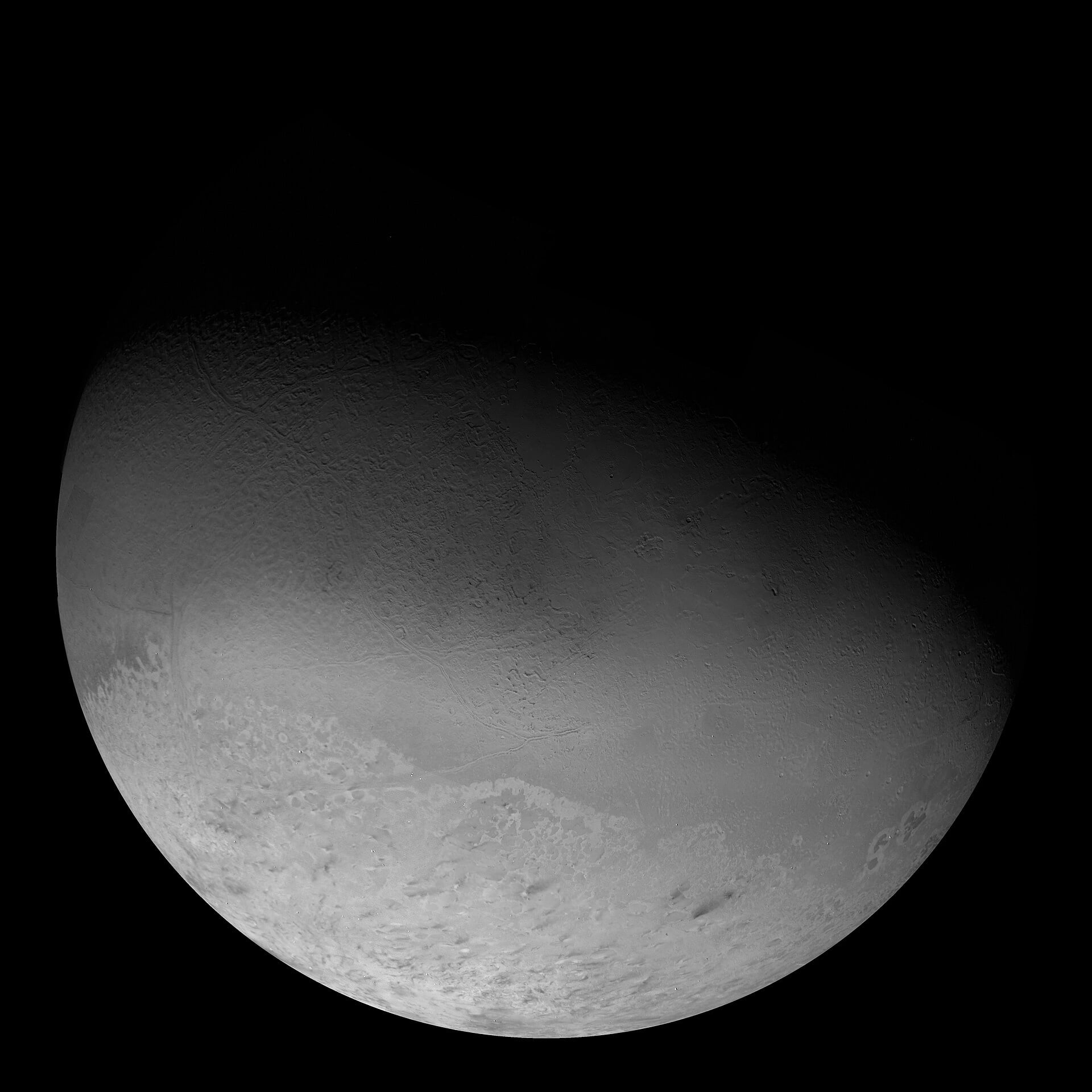
Triton is the largest natural satellite of the planet Neptune. It is the only moon of Neptune massive enough to be rounded under its own gravity and hosts a thin, hazy atmosphere. Triton orbits Neptune in a retrograde orbit—revolving in the opposite direction to the parent planet's rotation—the only large moon in the Solar System to do so. Triton is thought to have once been a dwarf planet from the Kuiper belt, captured into Neptune's orbit by the latter's gravity.
At 2,706.8 kilometers (1,681.9 mi) in diameter, Triton is the seventh-largest moon in the Solar System, the second-largest planetary moon in relation to its primary (after Earth's Moon), and larger than all of the known dwarf planets. The mean density is 2.061 g/cm3, reflecting a composition of approximately 30–45% water ice by mass, with the rest being mostly rock and metal. Triton is differentiated, with a crust of primarily ice atop a probable subsurface ocean of liquid water and a solid rocky-metallic core at its center. Although Triton's orbit is nearly circular with a very low orbital eccentricity of 0.00001, its interior may still experience tidal heating through obliquity tides.
From Wikipedia and its contributors, under CC BY-SA 4.0. Text reformatted for this reading view.