Moon
Natural satellite orbiting Earth
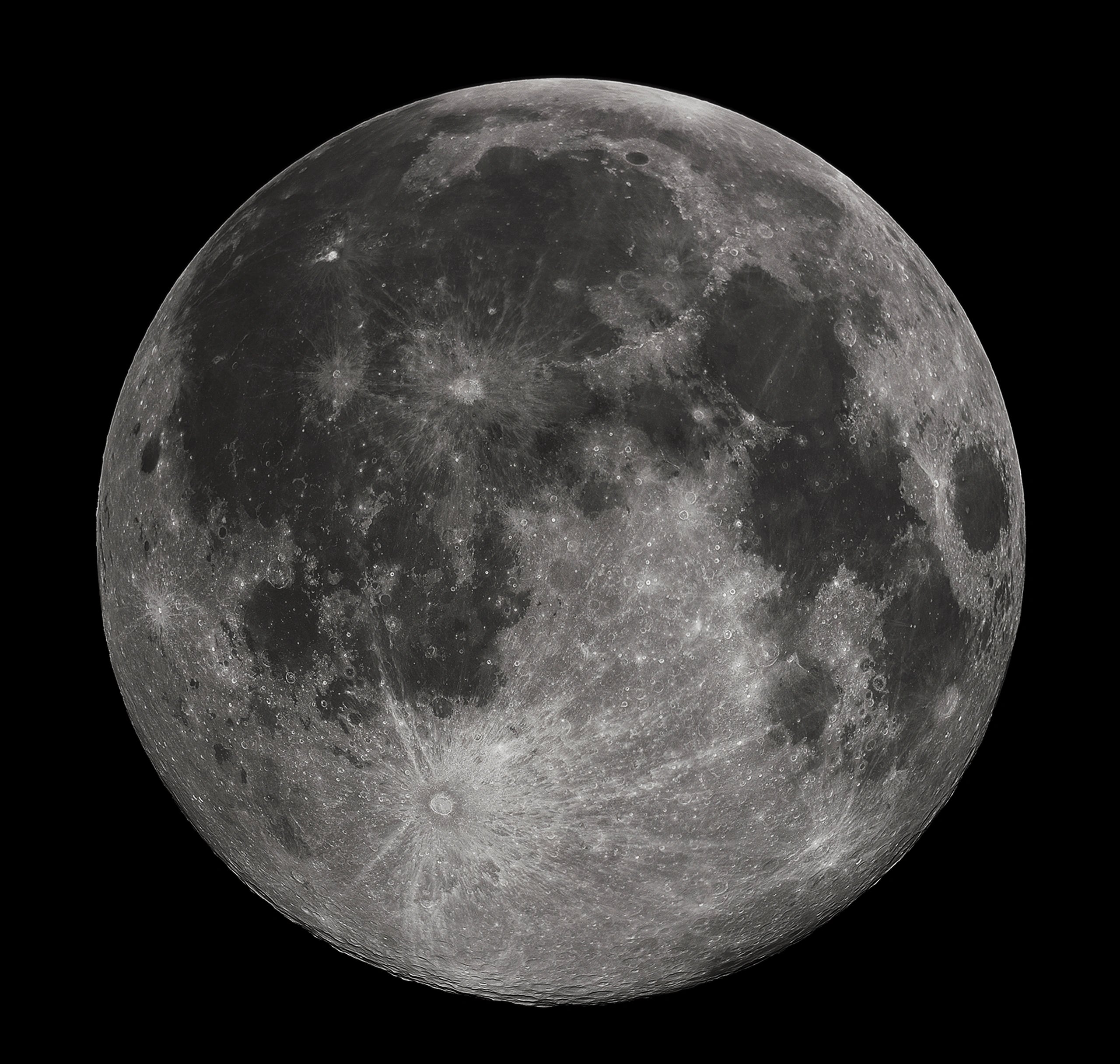
The Moon is the only natural satellite of Earth. It orbits Earth in an elliptical path, at a distance that varies over the year, averaging around 378,000 kilometers (235,000 mi). It completes an orbit (lunar month) in relation to Earth and the Sun (synodically) every 29.5 days. The Moon and Earth are bound by gravitational attraction, which is stronger on the sides facing each other. The resulting tidal forces are the main driver of Earth's tides, and have pulled the Moon to always face Earth with the same near side. This tidal locking effectively synchronizes the Moon's rotation period (lunar day) to its orbital period (lunar month).
In geophysical terms, the Moon is a planetary-mass object or satellite planet. Its mass is 1.2% that of the Earth, and its diameter is 3,474 km (2,159 mi), roughly one-quarter of Earth's (about as wide as the contiguous United States). Within the Solar System, it is larger and more massive than any known dwarf planet, and the fifth-largest and fifth–most massive moon, as well as the largest and most massive in relation to its parent planet. Its surface gravity is about one-sixth of Earth's, about half that of Mars, and the second-highest among all moons in the Solar System after Jupiter's moon Io. The body of the Moon is differentiated and terrestrial, with only a minuscule hydrosphere, atmosphere, and magnetic field. The lunar surface is covered in regolith dust, which mainly consists of the fine material ejected from the lunar crust by impact events. The lunar crust is marked by impact craters; some younger ones feature bright ray-like streaks. The Moon was volcanically active until 1.2 billion years ago, surfacing lava mostly on the thinner near side of the Moon, filling ancient craters, which through cooling formed the today prominently visible dark plains of basalt called maria ('seas'). The Moon is thought to have been formed out of material from Earth that was ejected by a giant impact of a Mars-sized body. Studies based on isotopic dating crystallization of the lunar magma ocean suggested that the Moon formed 4.35 billion years ago, late in the history of the Solar System.
From Wikipedia and its contributors, under CC BY-SA 4.0. Text reformatted for this reading view.