Europa (moon)
Smallest Galilean moon of Jupiter
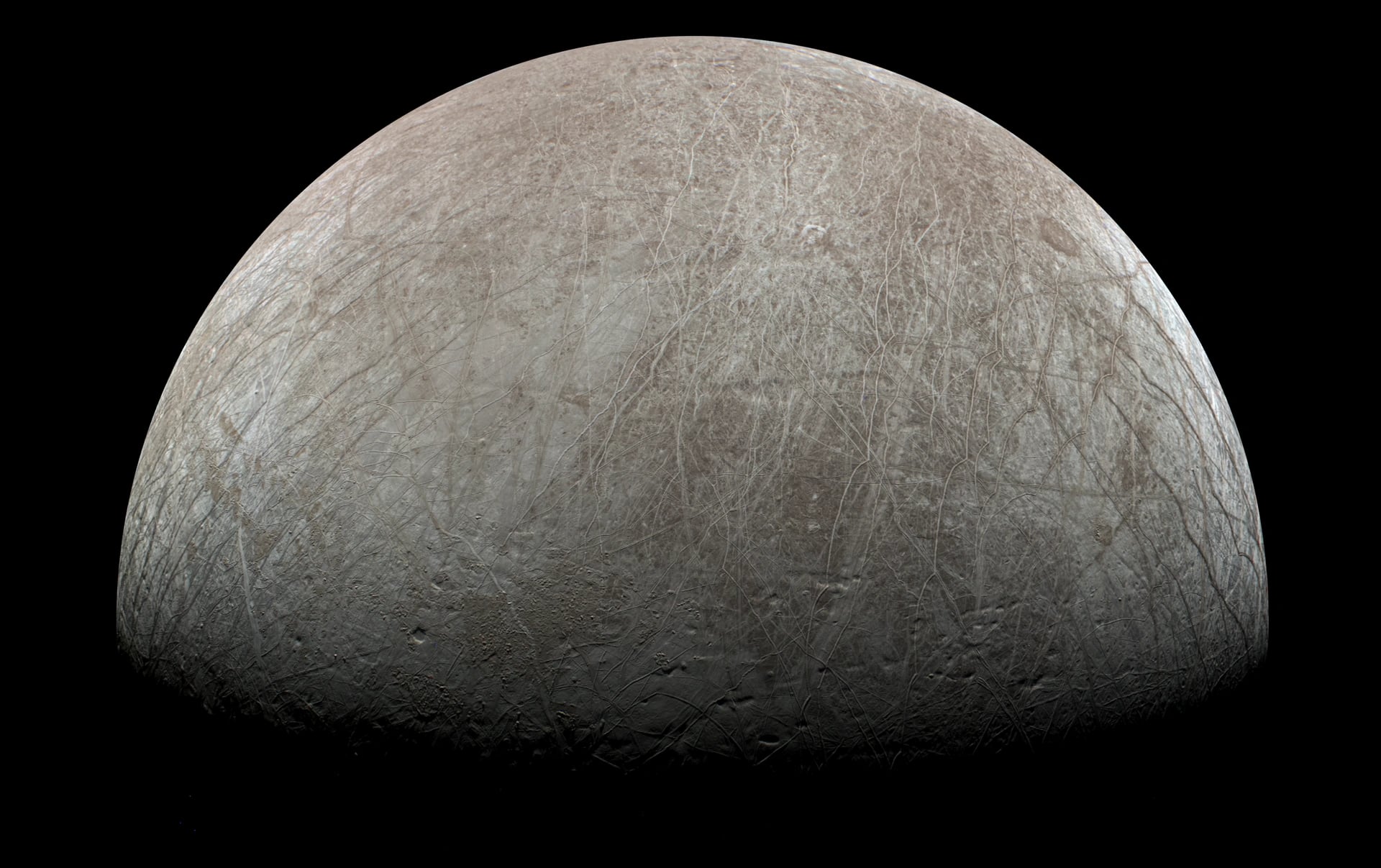
Europa ( ) or Jupiter II is the smallest and least massive of Jupiter's four Galilean moons. It is observable from Earth with common binoculars and is a planetary-mass moon, slightly smaller and less massive than Earth's Moon. Europa is an icy moon, and, of the three icy Galilean moons, the closest orbiting Jupiter. As a result, it exhibits a relatively young surface shaped by tidal heating.
Europa consists mainly of silicate rock, and potentially has an iron-nickel core. It has a very thin atmosphere composed primarily of oxygen. Europa has a pale, geologically young surface striated by light tan cracks and streaks; the surface lacks large-scale features such as mountains or craters, making the moon the smoothest known solid object in the Solar System. The apparent youth and smoothness of the surface is due to a water ocean beneath the surface, which could conceivably harbor extraterrestrial life. The predominant model suggests that heat from tidal flexing causes the ocean to remain liquid and drives ice movement similar to plate tectonics, absorbing chemicals from the surface into the ocean below.
From Wikipedia and its contributors, under CC BY-SA 4.0. Text reformatted for this reading view.