Callisto (moon)
Second-largest moon of Jupiter
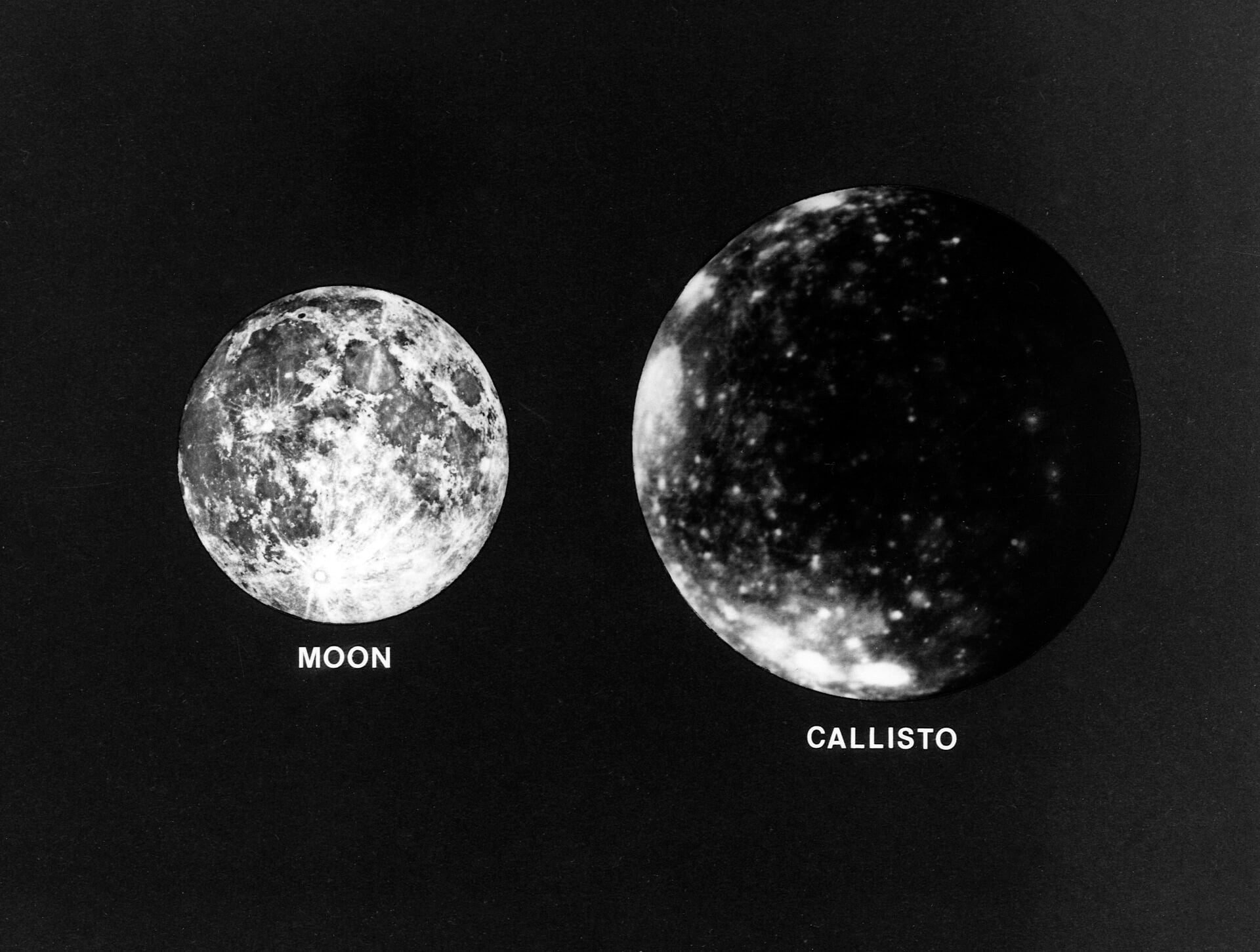
Callisto ( kə-LIST-oh) is the second-largest moon of Jupiter, after Ganymede. It is also the third-largest moon in the Solar System, following Ganymede and Saturn's moon Titan, and nearly as large as the planet Mercury, but only about a third of that planet's mass. With a diameter of 4,821 km, Callisto is roughly a third larger than Earth's Moon and orbits Jupiter on average at a distance of 1.883 million km, which is about five times further out than the Moon orbiting Earth. It is the outermost of the four large Galilean moons of Jupiter, which were discovered in 1610 with one of the first telescopes, and is today visible from Earth with common binoculars.
The surface of Callisto is the oldest and most heavily cratered in the Solar System, with the surface almost completely covered with impact craters. It does not show any signatures of subsurface processes such as plate tectonics or volcanism, and is thought to have evolved predominantly under the influence of impacts. Prominent surface features include multi-ring structures, variously shaped impact craters, and chains of craters called catenae and associated scarps, ridges and deposits. At a small scale, the surface is varied and made up of small, sparkly frost deposits at the tips of high spots, surrounded by a low-lying, smooth blanket of dark material. This is thought to result from the sublimation-driven degradation of small landforms, which is supported by the general deficit of small impact craters and the presence of numerous small knobs, considered to be their remnants. The absolute ages of the landforms are not known.
From Wikipedia and its contributors, under CC BY-SA 4.0. Text reformatted for this reading view.