Black hole
Compact astronomical body
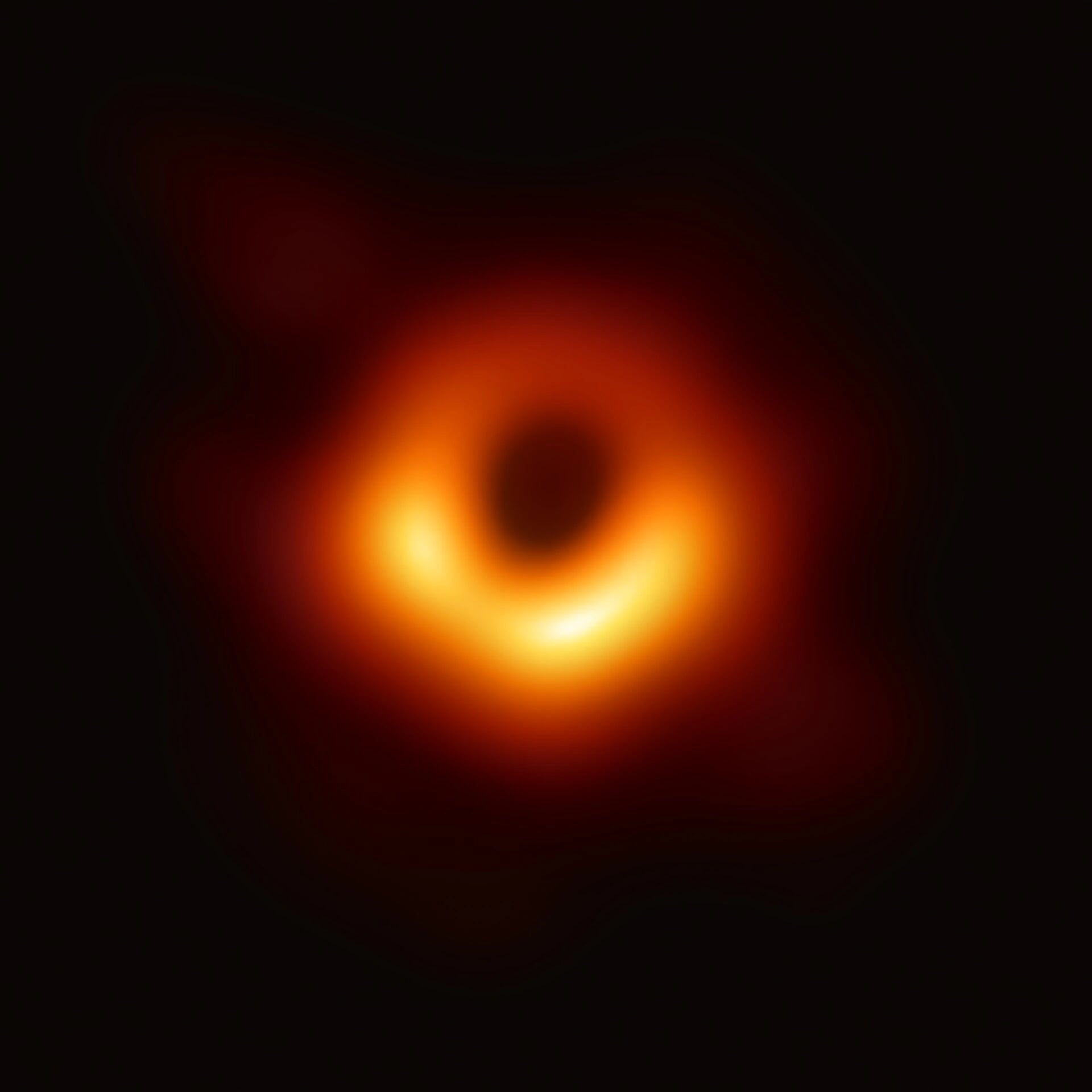
A black hole is an astronomical body so compact that its gravity prevents anything, including light, from escaping. Albert Einstein's theory of general relativity, which describes gravitation as the curvature of spacetime, predicts that any sufficiently compact mass will form a black hole. The boundary of no escape is called the event horizon. In general relativity, crossing a black hole's event horizon traps an object inside but produces no locally detectable change. General relativity also predicts that every black hole should have a central singularity, where the curvature of spacetime is infinite.
Objects whose gravitational fields are too strong for light to escape were first considered in the 18th century. In 1916, the first solution of general relativity that would characterise a black hole was found. By the late 1950s, this solution began to be interpreted physically as a region of space from which nothing can escape. Black holes were long considered a mathematical curiosity; it was not until the 1960s that theoretical work showed they were a generic prediction of general relativity. The first widely accepted black hole was Cygnus X-1, an x-ray source proposed as a black hole binary through several studies between 1971 and 1974.
From Wikipedia and its contributors, under CC BY-SA 4.0. Text reformatted for this reading view.