Imagination First
Eric Liu and Scott Noppe-Brandon
19m15 ch
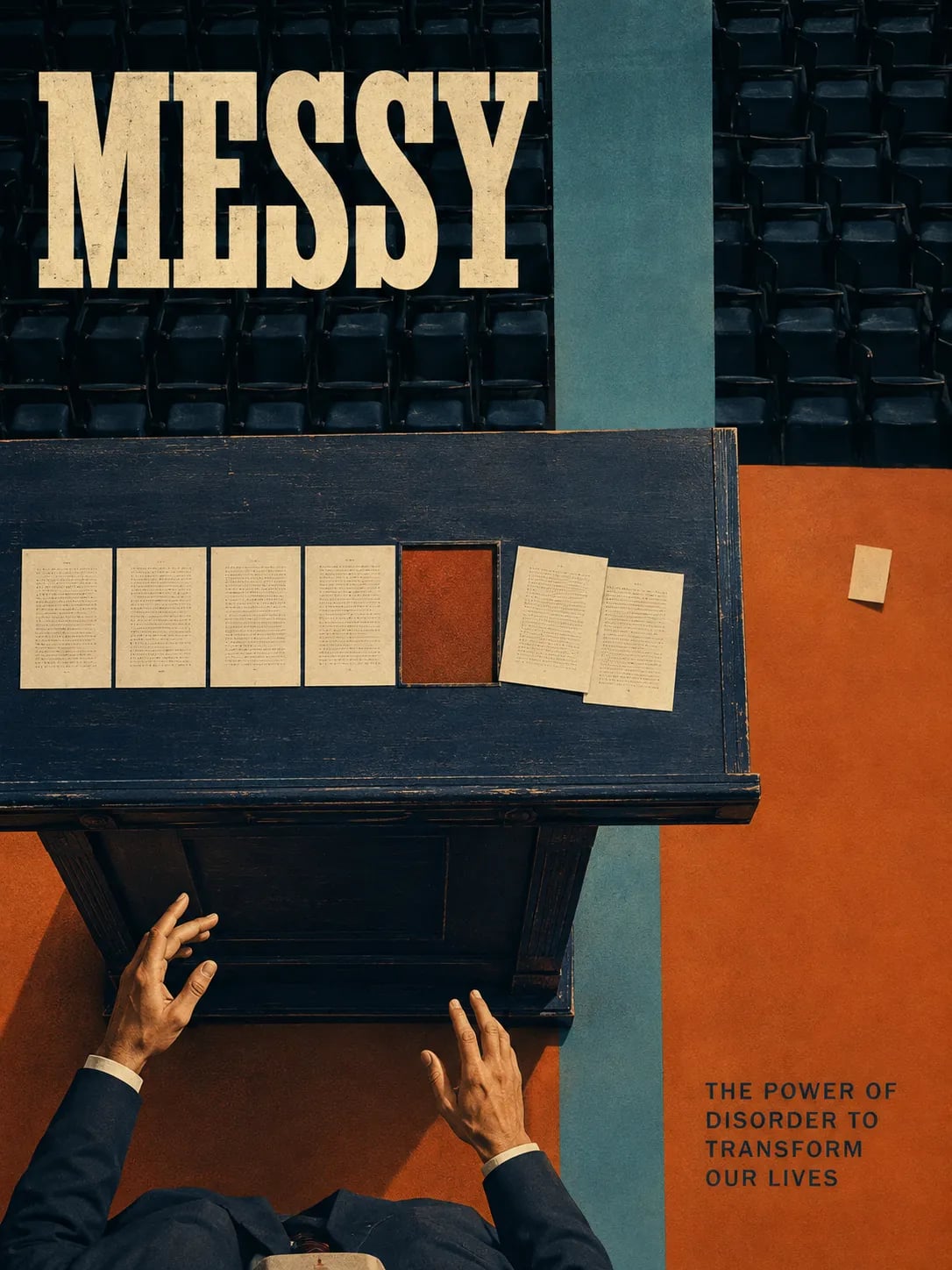
This book challenges the pervasive modern obsession with tidiness, order, and predictability. Through diverse case studies spanning art, science, business, and daily life, it demonstrates how embracing "mess"—improvisation, distraction, diversity, and imperfection—often leads to greater creativity, collaboration, and resilience. Readers discover how renowned figures like Keith Jarrett and David Bowie harnessed disorder for their greatest works, and how organizations like Amazon thrive on chaotic strategies. The author argues that our innate drive for order can hinder progress and adaptability, urging a re-evaluation of structured approaches. Ultimately, the book reveals that true innovation and human connection often emerge from the untidy, unquantified, and unpredictable aspects of existence.
Press play to hear the insight read aloud. Each word highlights in sync with the narration.
Intro
In a world constantly pushing us toward order, precision, and efficiency, there's a powerful, often overlooked force that sparks our greatest triumphs. Messiness. Far from being a flaw, a touch of disorder, a willingness to improvise, and an embrace of the unpredictable can unlock extraordinary creativity, foster deeper connections, and build remarkable resilience. This journey explores how letting go of rigid control and welcoming a degree of chaos can lead to magical moments in art, science, business, and even our daily lives, revealing a hidden virtue in the untidy, the unquantified, and the delightfully imperfect.
1. Unplayable Pianos and Creative Leaps
Unplayable pianos and creative leaps Imagine a young concert promoter's excitement for a sold -out improvised jazz concert. Only to discover the requested grand piano has been replaced by a tiny little bowsendorfer that is completely out of tune. The black notes in the middle didn't work, the pedal stuck, it was unplayable. This was the predicament of 17 -year -old Vera Brandis on January 27, 1975, for Keith Jarrett's Cologne concert. Initially, Jarrett was instinctually against playing, a feeling many would share when faced with substandard tools and high stakes. Yet this unplayable piano forced Jarrett into new territory. He avoided the tinny high notes, focused on the middle register, and used rumbling repetitive bass riffs to compensate for the lack of resonance, lending a translate quality to the performance. To achieve sufficient volume in the vast hall, he had to pummel the instrument, standing, sitting, moaning, and writhing, pushing the notes down with intense physical effort. The result? The performance of a lifetime, yielding the best -selling solo jazz album, the Cologne concert, with 3 .5 million copies sold. This wasn't a triumph despite adversity, but often the shortcomings themselves became a catalyst for genius, helping to shape an unexpected unique masterpiece.
Continue reading with the cont. app
The full chapter-by-chapter breakdown is waiting for you in the app.
Continue readingCore Idea: The Virtues of Messiness vs. The Tidiness Temptation
Our innate human urge for order, systematization, and predictability often leads us to seek "tidy-minded" approaches. This "tidiness temptation" can manifest as meticulously archiving emails, strictly adhering to scripts, or demanding perfectly organized workspaces.
However, the book argues that we frequently overlook the benefits of "messy" elements: the untidy, unquantified, uncoordinated, improvised, imperfect, ambiguous, or difficult. These disruptions, while initially uncomfortable, can spur creativity, nurture resilience, and bring out our best.
Messiness as a Catalyst for Creativity
Alertness and Engagement: Messy situations or random disruptions generate a crucial state of "alertness". When faced with the unexpected, we are forced to observe carefully and actively figure out our response, which is inherently stimulating and exciting. This contrasts with the boredom and passive engagement that can result from overly predictable environments.
Random Leaps and Cross-Pollination: Breaking routine and introducing random elements can lead to new insights. This can involve using flawed tools (like Keith Jarrett with the "unplayable" piano), applying cryptic instructions (Brian Eno's Oblique Strategies), or even deliberately reformatting documents into challenging fonts to heighten attention.
Project-Switching ("Network of Enterprises"): Working on multiple diverse projects in parallel allows for "cross-fertilization," where knowledge or solutions from one area unexpectedly help solve problems in another. This approach keeps ideas fermenting in the subconscious, provides fresh contexts that grab attention, and offers an escape from impasses in any single project.
The Unexpected Benefits of Improvisation
Letting Go of the Script: While careful preparation has its place, improvisation offers speed, economy, and crucial flexibility. It allows for real-time adaptation to evolving situations, whether in public speaking (like Martin Luther King Jr.'s "I Have a Dream" speech), customer service, or personal interactions.
Suppressing Self-Censorship: Improvisation can suppress conscious control and self-censorship, allowing the brain to make "random leaps" and connect disparate ideas that might otherwise be filtered out. This leads to freshness and authenticity.
"The Habit of Yes": In social interactions, adopting a "habit of yes" means opening up new conversational possibilities, embracing unexpected turns, and genuinely "entering their world," even in challenging situations like communicating with those suffering from dementia.
Mess as a Weapon for Winning
Disorientation and OODA Loops: In competitive environments (war, business, politics), intentionally creating a messy, unpredictable situation can disorient opponents and gain an advantage. By operating with speed and improvisation, one can get "inside the opponent's OODA loop" (Observe-Orient-Decide-Act), forcing them into a constant state of confusion and reaction.
Speed Over Perfection: Leaders like Rommel, Jeff Bezos, and Donald Trump demonstrated that a preference for rapid improvisation and seizing fleeting opportunities, even if it creates an "almighty mess," can outmaneuver more ponderous, tidy-minded adversaries. This "fast-and-messy" approach encourages experimentation and adaptation.
The Pitfalls of Tidy Targets and Over-Automation
Perverse Incentives: Imposing simple, quantifiable targets on complex systems often leads to unintended, negative consequences, as people "game" the system to meet the target rather than improve actual performance. Examples include ambulance services rerouting vehicles away from "breached" cases or universities manipulating application numbers to boost rankings.
Complexity vs. Simplicity: Making targets more complex does not stop gaming; it simply leads to more complex and unpredictable circumvention. Simple "rules of thumb" can often outperform complex algorithms, especially with limited data, but these rules become sources of distortion if formalized into targets. The solution lies in ambiguous regulation or unpredictable "stress tests".
Automation Bias and Erosion of Skills: Over-reliance on tidy automated systems can make humans less competent and more prone to large errors when the systems inevitably fail. Automated decision-making, while efficient for routine tasks, can foster passive acceptance and erode human judgment and adaptability, as seen in GPS navigation or critical system failures.
Resilience Through Diversity and Disorder
Ecological and Social Diversity: Diverse systems, whether natural (mixed forests, human microbiome) or social (cities, teams), are more robust and resilient. Monocultures, or tidying away seemingly unimportant elements, can introduce fragility and vulnerability to disease or unexpected challenges.
The Strength of Weak Ties and Cognitive Diversity: In collaborations, "bridging social capital" (connections with diverse, distant contacts) is crucial for innovation and fresh perspectives, complementing "bonding social capital" (strong ties within a close-knit group). Diverse teams "trump ability" by preventing groupthink and getting stuck in the same place, even if the interactions can be messy or awkward.
Embracing Ambiguity in Design: Deliberately designed ambiguity in physical spaces (like Hans Monderman's traffic-calming "Squareabouts" or MIT's reconfigurable Building 20) forces users to pay attention, engage their brains, and adapt, thus reducing the chance of large errors.
Messiness in Personal Life
Flexible Planning: Rigid, detailed daily plans often fail because life is inherently messy and unpredictable. Broader, more flexible plans, or even a deliberate refusal to schedule everything, allows for better adaptation to unexpected events and opportunities.
Organizing Information: Over-organizing documents or emails into complex folder structures can be counterproductive and time-consuming. Simple, pragmatic systems, like a messy desk where frequently used items remain accessible, or relying on search functions for digital files, are often more efficient.
Authentic Connection: Relying on algorithms or scripts for social interactions (like dating apps or formulaic social media responses) simplifies human connection and often misses what truly matters: genuine listening, risk-taking, and spontaneous engagement.
Children's Play: Overprotecting children and denying them opportunities for messy, free-form play can limit their development of crucial skills, resilience, and adaptability. Unstructured environments, even if they appear chaotic to adults, foster creativity and community-building.
Conclusion The pursuit of tidiness, while often well-intentioned, frequently masks underlying fragility and stifles our ability to thrive in a complex, unpredictable world. By understanding and embracing the power of disorder, improvisation, diversity, and purposeful ambiguity, we can unlock creativity, build resilience, and achieve greater success and fulfillment in all aspects of life.
More like this
Editorial insight by cont. Not affiliated with, endorsed by, or sponsored by the author or publisher. Buy or borrow the full book at Amazon.