
Quiet Leadership
David Rock
20m15 ch
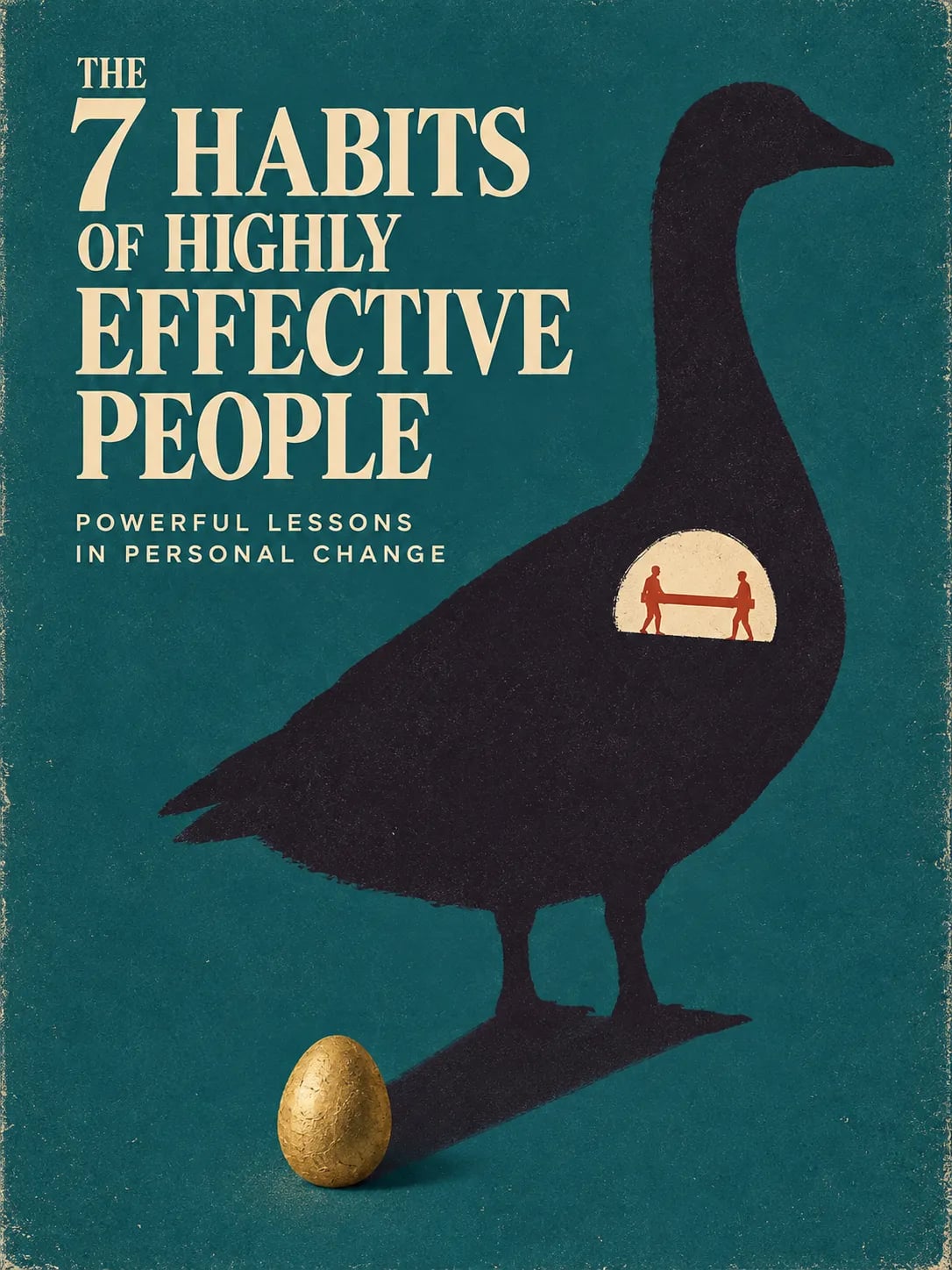
by Stephen R. Covey
The book begins by highlighting common struggles despite outward success, attributing them to a focus on superficial techniques rather than foundational character. It introduces the concept of paradigms, illustrating how our ingrained ways of seeing the world govern our behaviors and limit our effectiveness. Readers are then guided through a transformative "Inside-Out" journey, starting with personal mastery—becoming proactive, envisioning their desired future, and managing priorities based on core principles. This private victory establishes the bedrock for building powerful, trust-based relationships and achieving "Public Victories" through win-win thinking, empathic communication, and synergistic collaboration. Finally, the book emphasizes continuous self-renewal across physical, spiritual, mental, and social dimensions, providing a holistic framework for a life of integrity, contribution, and enduring effectiveness.
Press play to hear the insight read aloud. Each word highlights in sync with the narration.
Intro
Many of us dedicate tremendous effort to climb the ladder of success only to realize sometimes too late that it's leaning against the wrong wall. This journey invites us to explore a profound shift in perspective, moving beyond superficial fixes to discover a source of enduring happiness and effectiveness that lies deep within us and radiates outward to transform every aspect of our lives. Imagine a life where your actions are aligned with your deepest values, where your relationships are built on unwavering trust, and where every challenge becomes an opportunity for creative growth. This isn't a fleeting dream, but a powerful reality achievable by cultivating fundamental principles that govern human effectiveness, principles as constant and undeniable as the laws of nature itself.
1. The Fading Luster of Outward Appearances
The Fading Luster of Outward Appearances For the past 50 years, much of the prevailing wisdom on success has been a personality ethic. It's focused on surface -level techniques, public image, attitudes and behaviors that might temporarily smooth human interactions. You might find advice like smiling wins more friends than frowning, or your attitude determines your altitude. While elements like communication skills and positive thinking can be beneficial, they are ultimately secondary. This approach, however, often proves manipulative or deceptive, offering social band -aids and aspirin that treat acute symptoms but leave chronic underlying problems untouched to fester and resurface. It's like trying to navigate a complex city with a map of a different one. No matter how hard you try or how positive your attitude, you'll still be lost. Lasting success, relationships and genuine happiness cannot be built on a foundation of duplicity or insincereity. What we are communicated far more eloquently than anything we say or do.
Continue reading with the cont. app
The full chapter-by-chapter breakdown is waiting for you in the app.
Continue readingThis book outlines the core philosophy and practical applications for achieving effectiveness and personal growth, emphasizing an "Inside-Out" approach and the power of principles.
I. Core Philosophy & Foundational Concepts
The Quest for Meaning: Many people, despite professional success, experience an inner struggle or a feeling of "eating my heart out," indicating a disconnect between outward appearance and inner satisfaction, and a desire for genuine effectiveness and fulfillment.
Character Ethic vs. Personality Ethic:
For the first 150 years (since 1776), success literature focused on the character ethic, emphasizing integrity, humility, fidelity, temperance, courage, justice, patience, simplicity, modesty, and the Golden Rule as foundations for true success and enduring happiness.
After World War I, the view shifted to the personality ethic, focusing on public image, attitudes, behaviors, skills, and techniques to "lubricate" human interaction (e.g., positive mental attitude, human relations techniques). While sometimes beneficial, these are considered secondary traits and are often manipulative "quick fixes" that leave underlying chronic problems untouched.
Primary vs. Secondary Greatness: Success comes from primary greatness (goodness in character), while social recognition for talents (secondary greatness) without character leads to relationship failures. Only basic goodness gives life to technique.
Paradigms and Paradigm Shifts:
A paradigm is a model, theory, perception, assumption, or frame of reference – essentially, the way we "see" the world. These are like maps; if you have the wrong map, no amount of effort or positive attitude will get you to the right destination.
Our attitudes and behaviors flow from our mental maps.
A Paradigm Shift is an "Aha!" experience where someone finally "sees" a situation in a completely different way. This is crucial because our paradigms, whether correct or incorrect, are the source of our attitudes and behaviors, and ultimately our relationships. The shift from character ethic to personality ethic was a negative paradigm shift.
The "Inside-Out" Approach:
This book advocates a principle-centered, character-based, "Inside-Out" approach to effectiveness.
It means starting first with the self—specifically, with your paradigms, character, and motives.
Private Victories™ precede Public Victories™; improving oneself (e.g., being trustworthy) is essential before improving relationships with others (e.g., being trusted). It's a continuous process of renewal based on natural laws of growth.
Habits Defined: A habit is the intersection of knowledge (what to do and why), skill (how to do), and desire (want to do). Creating a habit requires work in all three dimensions.
The Maturity Continuum™: The Seven Habits provide an incremental, sequential approach moving from dependence to independence to interdependence.
Dependence: "You take care of me" (e.g., physical dependence, emotional dependence on others' opinions for self-worth, intellectual dependence on others to think for you).
Independence: "I can do it myself" (e.g., physical self-reliance, mental self-thinking, emotional validation from within). This is a worthy, liberating goal but not the ultimate one.
Interdependence: "We can do it together" – independent individuals choosing to cooperate effectively. This is the highest form of maturity, allowing access to vast resources and potential of others.
The P/PC Balance™ (Production/Production Capability):
True effectiveness is a function of P (Production) – the desired results (e.g., golden eggs) – and PC (Production Capability) – the asset or ability that produces those results (the goose).
Neglecting PC for P will eventually destroy the ability to produce (e.g., overworking a machine, invading financial principal, neglecting relationships).
Effectiveness lies in the balance between P and PC. This balance applies to physical, financial, and human assets.
II. The Seven Habits
A. Private Victories (Moving from Dependence to Independence)
Habit 1: Be Proactive™ – Principles of Personal Vision
Self-awareness: The unique human capacity to think about your own thought process. It allows us to evaluate, learn, make/break habits, and choose our response between stimulus and reaction, liberating us from determinism (genetic, psychic, environmental). Viktor Frankl's experience in Nazi death camps exemplifies this.
Human Endowments: Besides self-awareness, we have imagination (create beyond present reality), conscience (inner awareness of right/wrong), and independent will (act based on self-awareness). These allow us to "write new programs for ourselves".
"Proactivity" Defined: Means we are responsible for our own lives. Our behavior is a function of decisions, not conditions. We can subordinate feelings to values. It means taking initiative and being "response-able" – the ability to choose your response.
Circle of Concern vs. Circle of Influence:
Circle of Concern: Things we care about but have no real control over (e.g., national debt, weather). Reactive people focus here, empowering external factors to control them.
Circle of Influence: Things we can do something about. Proactive people focus here, expanding their influence. This involves working on "be" (what we are) rather than "have" (what we possess).
Proactive Language: Focuses on choice ("I can choose," "I prefer," "I will") rather than victimhood ("I can't," "I have to," "He makes me mad").
Love as a Verb: Proactive people make love a verb—an action (sacrifice, listening, empathizing, appreciating, affirming)—not just a feeling.
Proactive Approach to Mistakes: Acknowledge instantly, correct, and learn from them to turn failure into success. Not acknowledging them leads to self-deceiving, self-justifying paths.
Making and Keeping Commitments: This is at the heart of the Circle of Influence. Integrity is the ability to make and keep commitments to ourselves, to "walk our talk". This builds character and inner integrity.
Habit 2: Begin with the End in Mind™ – Principles of Personal Leadership
Vision and Values: Visualize your own funeral to identify deep, fundamental values and define success.
First and Second Creation: All things are created twice.
First Creation: The mental blueprint or vision (e.g., architectural plans for a house). This is leadership.
Second Creation: The physical manifestation (e.g., building the house). This is management.
By Design or Default: If we don't consciously design our first creation, others or circumstances will script our lives by default.
Rescripting: Using self-awareness, imagination, and conscience to write our own scripts, replacing ineffective ones. Anwar Sadat's story is a powerful example of rescripting his deeply ingrained hatred for Israel. We can live "out of my imagination instead of my memory" and connect to "limitless potential instead of my limiting past".
Personal Mission Statement: A "personal constitution" that focuses on what you want to be (character) and do (contributions, achievements), based on values and principles. It provides a fundamentally changeless frame of reference for daily decisions. Frankl's "logotherapy" helps detect unique meaning in life.
Principle-Centered Living: Centering life on correct principles provides an "immovable, unchanging, unfailing core" for security, guidance, wisdom, and power. It contrasts with "other centers" (spouse, family, money, work, possessions, pleasure, friends/enemies, church, self) which lead to instability and limitations.
Whole-Brain Thinking: Effective first creation requires using both the logical/verbal left brain and the intuitive/creative right brain. Visualization and affirmation are powerful right-brain tools for rescripting and integrating mission into daily life.
Habit 3: Put First Things First™ – Principles of Personal Management
The Second Creation: This habit is the physical creation, the day-to-day "doing" of Habits 1 and 2.
Power of Independent Will: The ability to make decisions and choices and to act in accordance with them, even when it's difficult. This is measured by personal integrity – our ability to make and keep commitments to ourselves, to "walk our talk".
Effective Management: Is about putting first things first. It's discipline: subordinating feelings, impulses, and moods to values. It requires a clear purpose and a "burning Yes!" inside to say "no" to other things.
Fourth Generation Time Management: Focuses on managing ourselves, not just time. It prioritizes relationships and results (P/PC Balance).
Quadrant II Focus: The heart of effective personal management. It deals with things that are important but not urgent (e.g., building relationships, long-range planning, exercise, preventive maintenance).
Quadrant I: Urgent & Important (crises, problems).
Quadrant III: Urgent & Not Important (interruptions, others' priorities).
Quadrant IV: Not Urgent & Not Important (trivia, escape activities).
Spending time in Quadrant II shrinks Quadrant I.
Saying "No": To say "yes" to important Quadrant II priorities, you must have the courage to say "no" to other things, often urgent ones. The "good" can be the "enemy of the best". This requires a "bigger 'yes' burning inside".
Quadrant II Organizing (Weekly): Organizing on a weekly basis provides greater balance and context than daily planning. The key is to schedule your priorities. This involves:
Identifying Roles: (e.g., individual, parent, manager).
Selecting Goals: 2-3 important results for each role for the week (Quadrant II activities).
Scheduling: Allocating specific time blocks for goals, including "Sharpen the Saw" activities.
Daily Adapting: Reviewing the schedule and prioritizing based on values, remaining flexible for unanticipated events.
Delegation: Increasing P and PC.
Gofer Delegation: Supervising methods, requiring constant oversight (e.g., "do this, do that"). Limited and inefficient.
Stewardship Delegation: Focuses on results, not methods. Gives people choice of method and makes them responsible for results. Requires clear, mutual understanding and commitment in five areas: Desired Results, Guidelines, Resources, Accountability, and Consequences. It is based on appreciating others' endowments (self-awareness, imagination, conscience, free will).
B. Public Victories (Moving from Independence to Interdependence)
Foundation: Effective interdependence is built on a foundation of true independence. Private Victory precedes Public Victory.
The Emotional Bank Account™: A metaphor for trust in a relationship.
Deposits: Courtesy, kindness, honesty, keeping commitments, genuine listening. High trust leads to easy, effective communication and forgiveness.
Withdrawals: Discourtesy, disrespect, breaking promises, overreacting, betrayal. Overdrawn accounts lead to tension, defensiveness, and guarded communication.
Key Deposits:
Understanding the Individual: Seeking to understand what constitutes a deposit for the other person by genuinely understanding their needs and interests.
Attending to the Little Things: Small kindnesses and courtesies are crucial; small discourtesies are large withdrawals.
Keeping Commitments: Major deposit; breaking promises is a major withdrawal.
Clarifying Expectations: Root of almost all relationship difficulties. Explicitly stating and agreeing on expectations prevents misunderstanding and builds trust.
Showing Personal Integrity: Goes beyond honesty; it's conforming reality to your words by keeping promises and fulfilling expectations. Being loyal to those not present builds trust with those present. Avoiding deceptive communication.
Apologizing Sincerely When You Make a Withdrawal: "I was wrong," "I'm sorry". Apologies must be sincere and perceived as sincere to be a deposit.
Habit 4: Think Win-Win™ – Principles of Interpersonal Leadership
Win-Win Paradigm: A frame of mind and heart that constantly seeks mutual benefit in all human interactions. Solutions are mutually beneficial and satisfying, where all parties feel good and committed. It views life as a cooperative, not competitive, arena. It's based on the Abundance Mentality – there is plenty for everybody, and one person's success does not come at the expense of others.
Alternatives:
Win-Lose: Authoritarian, uses power/position/credentials. Scripted by comparison (family, peers, academics, athletics, law).
Lose-Win: Quick to please/appease, seeks popularity, lacks courage to express own convictions. Can be exploited by Win-Lose people.
Lose-Lose: When two Win-Lose people interact; both become vindictive and want to "get back," leading to mutual destruction.
Win: Focuses only on self's success, without concern for others.
Which Option Is Best? Depends on the reality of the situation. In interdependent realities, Win-Win is the only viable long-term alternative.
Win-Win or No Deal™: If a mutually beneficial solution cannot be found, agree to disagree agreeably. It's better not to make a deal than to live with a decision that isn't right for both. This provides emotional freedom and removes the need to manipulate.
Five Dimensions of Win-Win:
Character: Foundation of Win-Win, requiring integrity (self-awareness, independent will, keeping commitments), maturity (balance between courage and consideration), and Abundance Mentality™ (plenty for everyone, seeing life cooperatively, no need to compare).
Relationships: Built on trust (high Emotional Bank Account). Trust allows for open, mutual learning and creativity, and the search for a "Third Alternative" (synergistic solution).
Agreements (Performance/Partnership Agreements): Define and direct Win-Win interactions. These clarify expectations and manage results, shifting from hovering supervision to self-supervision. They involve five elements: Desired Results, Guidelines, Resources, Accountability, and Consequences.
Systems: Must support Win-Win. If management talks Win-Win but rewards Win-Lose, the program will fail. Aligning reward systems with Win-Win goals is crucial.
Processes: The means must align with the ends. To achieve Win-Win solutions, use Win-Win processes. This involves a 4-step process: 1) See the problem from the other point of view, 2) Identify key issues (not positions), 3) Determine acceptable results, 4) Identify new options.
Habit 5: Seek First to Understand, Then to Be Understood™ – Principles of Empathic Communication
The Principle: The single most important principle in interpersonal relations. It means to diagnose before you prescribe.
Character and Trust: You cannot genuinely understand or influence others with technique alone. It requires a character that inspires openness and trust and a positive Emotional Bank Account. Your example and conduct radiate your true character.
Empathic Listening: Listening with the intent to understand. Most people listen with the intent to reply, filtering through their own paradigms ("autobiographical responses").
It goes beyond mirroring content or rephrasing. It involves listening with ears, eyes, and heart for feeling, meaning, and body language.
It provides accurate data by dealing with the reality inside another person's head and heart.
It makes tremendous deposits in the Emotional Bank Account because it gives a person "psychological air" (the need to be understood, affirmed, validated, appreciated). Satisfied needs do not motivate; only unsatisfied ones do.
It's risky because it requires you to be open to being influenced; in order to influence, you must be influenceable.
Autobiographical Responses: Common reactive responses that prevent true understanding:
Evaluate: Agreeing or disagreeing.
Probe: Asking questions from your own frame of reference (controlling, invading).
Advise: Giving counsel based on your own experience.
Interpret: Trying to figure people out based on your own motives/behavior.
Then Seek to Be Understood: The second half of Habit 5. Requires courage.
Draws on the Greek philosophy of Ethos, Pathos, and Logos:
Ethos: Personal credibility, integrity, trust (your Emotional Bank Account).
Pathos: The empathic side, aligning with the other person's emotional trust.
Logos: The logic, reasoning part of the presentation.
The sequence is crucial: Ethos, Pathos, then Logos. When you understand their paradigms, you can present your ideas contextually and increase credibility.
One-on-One: Habit 5 is powerful because it's in your Circle of Influence. Listening deeply, understanding, and building trust empowers influence.
Habit 6: Synergize™ – Principles of Creative Cooperation
Synergy Defined: The whole is greater than the sum of its parts (1 + 1 = 3 or more). It's the most catalytic, empowering, unifying, and exciting part of relationships.
Essence: To value differences – mental, emotional, psychological differences between people. Recognizing that people see the world not as it is, but as they are.
Creative Process: Synergy is the "Third Alternative" – a solution better than any originally proposed, where all parties genuinely enjoy the creative enterprise. It requires openness, vulnerability, and leaving the comfort zone.
Synergistic Communication: Opening your mind, heart, and expressions to new possibilities and alternatives. It's a collective agreement to subordinate old scripts and write new ones.
Intrapersonal Synergy: The key to interpersonal synergy is synergy within ourselves, linking the analytical (left brain) and creative (right brain). This integrated thinking is best suited to the reality of life, which is both logical and emotional.
Force Field Analysis: Synergy is powerful in dealing with negative forces that resist growth and change. Instead of increasing driving forces (which create resistance), synergy works on transforming restraining forces.
Applications: Synergy is evident in nature (ecology). It applies to families, businesses, and all human interactions, creating unity, teamwork, and innovation.
C. Renewal (Continuous Improvement)
Habit 7: Sharpen the Saw™ – Principles of Balanced Self-Renewal
Concept: Taking time to preserve and enhance the greatest asset you have – yourself. It makes all other habits possible.
Four Dimensions of Our Nature: Consistent, regular renewal across these dimensions:
Physical: Caring for your body through proper eating, rest, and regular exercise (endurance, flexibility, strength). This is a Quadrant II activity; neglecting it leads to Quadrant I crises. It also builds Habit 1 muscles of proactivity.
Spiritual: Renewing your core, center, and commitment to your value system. This provides leadership to your life and is tied to Habit 2. Achieved through prayer, meditation, scripture study, great literature, music, or connecting with nature. Requires investment of time.
Mental: Continuing education, expanding the mind. Involves serious reading (e.g., a book a month/week), analytical thinking, and writing (journaling, letters). It allows you to examine your own programs and paradigms.
Social/Emotional: Renews relationships through effective interaction with others (Habits 4, 5, 6). It doesn't take separate time but requires exercising courage and consideration in daily interactions. It draws on inner security from principle-centered living. A key source is service and contributing to others' lives.
"Daily Private Victory": Dedicating one hour a day, every day, to renewing the physical, spiritual, and mental dimensions. This hour significantly improves the quality and effectiveness of all other hours.
Scripting Others: We can choose to reflect back a clear, undistorted vision to others, affirming their proactive nature and helping them become principle-centered, independent individuals. This is an act of an Abundance Mentality, and it benefits everyone.
Balance in Renewal: Neglecting any one dimension negatively impacts the others. Balanced renewal is optimally synergistic.
The Upward Spiral: Renewal is the principle and process that empowers continuous improvement. It requires learning, committing, and doing on increasingly higher planes. Educating and obeying our conscience (which senses congruence with correct principles) propels us along this spiral. Guarding our inner life from negative influences is essential for nurturing conscience.
III. Conclusion: Inside-Out Again
True change comes from the Inside-Out – from striking at the root (paradigms, character, motives) rather than hacking at the leaves (attitudes, behaviors).
The ability to use the gap between stimulus and response (Habit 1) empowers individuals from the Inside-Out.
Living by correct principles (the changeless core) allows us to adapt to change.
We can become "transition persons", breaking negative generational scripting and influencing lives downstream.
Achieving unity and oneness with self and others is the highest fruit of the Seven Habits.
It's a process, not a quick fix, requiring patience and persistent effort.
Correct principles are natural laws, rooted in a divine source, and aligning with them releases divine endowments within our nature.
More like this
Editorial insight by cont. Not affiliated with, endorsed by, or sponsored by the author or publisher. Buy or borrow the full book at Amazon.